Spelling Bee vs Blossom: The Differences That Change How You Play
The New York Times Spelling Bee and Merriam-Webster’s Blossom look almost identical: seven letters, one required centre letter, words of four letters or more. They reward opposite skills. Spelling Bee asks you to find as many words as you can, and every word counts. Blossom gives you only 12 words and scores you on choosing the best ones, with a moving bonus petal that makes timing matter. Blossom is also free to play in full, while Spelling Bee now stops free players after a few words.
Spelling Bee vs Blossom: side by side
| NYT Spelling Bee | Merriam-Webster Blossom | |
|---|---|---|
| Letters | 7 in a honeycomb, centre letter required | 7 in a flower, centre letter required |
| Minimum word length | 4 letters | 4 letters |
| How many words | As many as you can find | Exactly 12 |
| 4-letter word | 1 point | 2 points |
| Longer words | 1 point per letter | 5 = 4, 6 = 6, 7 = 12, then +3 per extra letter |
| Pangram | +7 points; every puzzle has at least one | +7 points |
| Bonus letter | None | Highlighted petal: +5 for every use of its letter, moves after every word |
| Ranks | From Beginner up to Genius (70% of the day’s points); Queen Bee for finding every word | Blossom Boss (300+ points), Mega Boss (350+) |
| Cost | A few words free, then a New York Times Games subscription (standard rate about $50 a year) | Free |
| New puzzle | 3 AM Eastern Time | Midnight Eastern Time (times by country) |
The same word is worth very different amounts
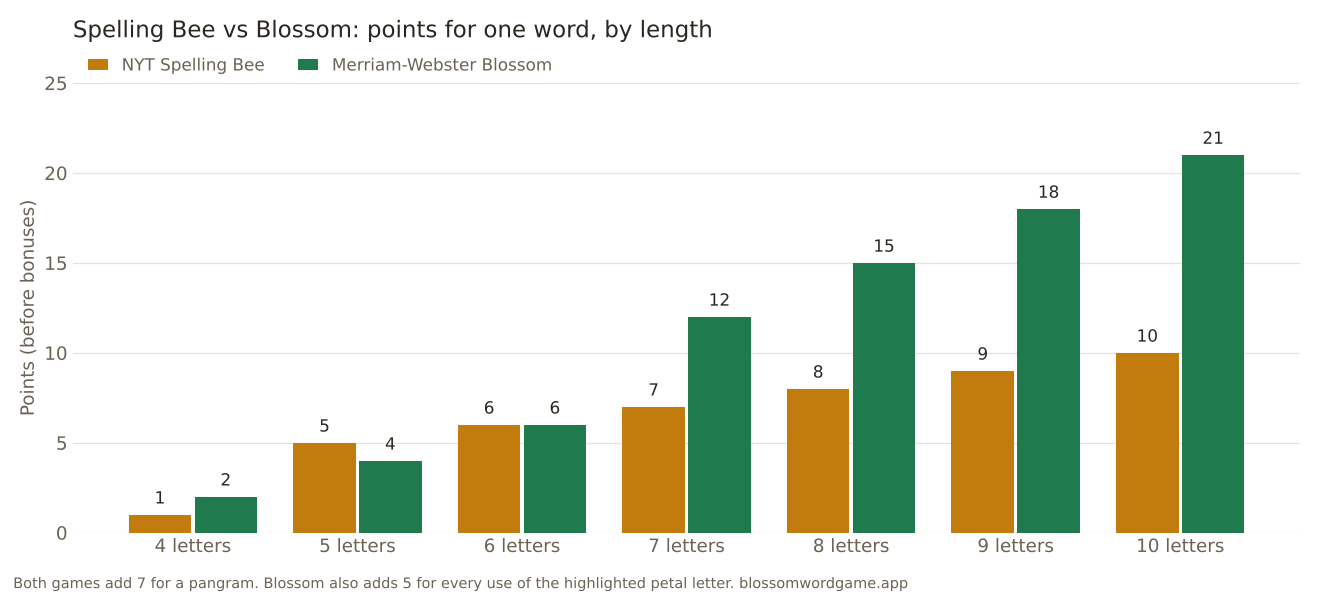
Take a 9-letter word. In Spelling Bee it scores 9 points, and it’s one of perhaps dozens of words you’ll find that day. In Blossom it scores 18 before bonuses, and if it uses the highlighted letter three times it scores 33. It also uses up one of only 12 slots.
That’s why short words are fine in Spelling Bee and a trap in Blossom. In Spelling Bee a 4-letter word is a free point that brings you closer to Genius. In Blossom a 4-letter word scores 2 points and costs you a slot that a long word could have filled.
How the strategy changes
| Spelling Bee habit | What to do in Blossom instead |
|---|---|
| Enter every word you spot | Shortlist first, submit second: you only get 12 |
| Short words are steady points | Skip 4- and 5-letter words almost entirely |
| The pangram is the big prize | The pangram is useful, but repeated bonus letters are often worth more (why) |
| Order doesn’t matter | Order matters: play each word when its best petal is highlighted |
| Goal: find all the words | Goal: choose the 12 best words (what Boss scores take) |
That change of habit is the whole Spelling Bee vs Blossom story in one table: Spelling Bee rewards finding words, Blossom rewards choosing and timing them.
Spelling Bee vs Blossom: what a top score looks like
The biggest Spelling Bee vs Blossom difference shows up in the numbers. In Spelling Bee, a top score means finding most of the day’s words: Genius takes 70% of the available points. In Blossom you only ever enter 12 words, so a top score is about choosing well.
- Lots of words, few slots. Across the 29 official Blossom puzzles from October 26 to November 23, 2026, our word list found 185 valid answers per puzzle on average (from 81 to 474). You get to use 12 of them.
- The best possible 12-word score averaged 394 points. That clears Blossom Boss (300) every day, but it fell short of Mega Boss (350) on 5 of the 29 days.
- The bonus petal supplied 39% of those best scores. Spelling Bee has nothing like it, which is why timing matters in Blossom and not in Spelling Bee (see the data).
You can play Spelling Bee on The New York Times’ Spelling Bee page and Blossom on Merriam-Webster’s Blossom page.
Spelling Bee vs Blossom: which one should you play?
- Play Spelling Bee if you enjoy long, open-ended sessions of finding every word, and you have, or want, a New York Times Games subscription.
- Play Blossom if you want a free daily puzzle you can finish in a few minutes, where judgement and timing count as much as vocabulary.
- Play both and the skills carry over. Spotting long words and pangrams in Spelling Bee helps your Blossom shortlist, and Blossom trains you to look for words that repeat letters.
You can play today’s Blossom letters in our free game, and get spoiler-free help on our Blossom hints and answers for today.
FAQ
Is Blossom the same as Spelling Bee?
No. Both use seven letters with a required centre letter, but Spelling Bee rewards finding as many words as possible, while Blossom limits you to 12 words and adds a bonus petal worth +5 for every use of its letter.
Is Blossom free to play?
Yes. Merriam-Webster’s Blossom is free with no subscription. The New York Times Spelling Bee lets free players enter only a few words before asking for a Games subscription.
Which is harder, Spelling Bee or Blossom?
They’re hard in different ways. Spelling Bee’s Genius and Queen Bee ranks test how many words you know; Blossom’s Boss ranks test how well you choose and time just 12 words.
Does Spelling Bee have a bonus letter like Blossom?
No. Spelling Bee has no bonus letter. Its only bonus is +7 points for a pangram.
Is Blossom a New York Times game?
No. Blossom is published by Merriam-Webster. See Is Blossom a New York Times game?